
Laser-Machined Interposer with Diamond-Coated Capillary Surfaces for Hotspot Mitigation in 3D Heterogeneous Integration (3DHI) Packaging
Paper details
Section titled “Paper details”| Field | Value |
|---|---|
| Journal | IMAPSource Proceedings |
| Published | 2026-06-17 |
| Authors | Stephanie Moore, Matt Bauer, Saeed Moghaddam |
| DOI | 10.4071/001c.163572 |
A laser-machined interposer with diamond-coated capillary surfaces is proposed to cut hotspot temperature by more than 20% inside a fixed package footprint. The design places a capillary-fed two-phase thermal path inside the interposer layer rather than above it. Laser-formed micropillar wicks use a sapphire base with a diamond skin between 5 nm and 750 nm thick. Multiphysics simulation at a constant input heat flux of 10 W/cm² gives a stable meniscus and continued capillary supply, with no dry-out events in the modeled unit cell.
The thermal bottleneck in 3DHI packages
Section titled “The thermal bottleneck in 3DHI packages”Local hotspot heat fluxes can approach hundreds of W/cm² in advanced packages. Chip power densities keep rising, heat must travel through vertically constrained pathways, and the resulting local hotspots become performance limiting. Conventional spreading approaches struggle at the package scale. A December 2025 Cadence overview cited in the paper links the temperature gradient to thermal failure, timing delays, mechanical stress, and lifetime reduction.
Each existing cooling technology carries a limitation. Heat spreaders are mature but give limited hotspot mitigation. Vapor chambers spread heat well but sit above the package. Microchannels offer high heat transfer coefficients while adding pumping complexity. Interposer cooling sits close to the heat source but faces a manufacturing challenge. The authors read this as a reason to build cooling architecture into the layer that holds the chip.
A capillary two-phase path inside the interposer
Section titled “A capillary two-phase path inside the interposer”The interposer combines micropillar wicks with copper vias. The wicks retain and redistribute liquid. The vias maintain electrical communication through the interposer.
The operating principle runs in four steps. The hotspot drives evaporation laterally, vapor spreads the heat, a condenser rejects the heat, and the capillary wicks return the liquid. Latent heat transport carries a large amount of heat at a small temperature rise.
Laser manufacturing supplies the wick architecture. The pattern is precise, so it creates a controllable capillary network. Ordered geometry lets the design tune capillary pressure and permeability. High aspect ratios raise evaporation area inside a thin package footprint. The process scales to thermal-interposer integration. No external pumping architecture is required.
Sapphire substrate with a diamond-coated wick surface
Section titled “Sapphire substrate with a diamond-coated wick surface”The authors choose sapphire for the wick body. It raises structural integrity, matches the coefficient of thermal expansion of silicon, and machines by laser etching.
A comparison of candidate wicking structures follows.
| Feature | Sintered alumina wick | Sintered copper wick | Sapphire with nano-diamond |
|---|---|---|---|
| Thermal conductivity | Very low, under 10 W/m·K | High, 50 to 100 W/m·K | Sapphire base 40 W/m·K, diamond skin 200 to 1000 W/m·K |
| Capillary effects | Random pores, high flow resistance, hard to optimize | Random pores, good capillary force, high flow resistance | Ordered geometry, permeability decoupled from capillary pressure |
| Heat transfer | Poor, insulates the working fluid from the heat source | Efficient, conducts heat to the evaporation interface | Diamond skin spreads heat laterally at the micro level to suppress hot spots |
| Durability | Brittle, prone to cracking and particle generation | Ductile but soft, deforms under pressure, chemical erosion | Chemically inert, erosion proof, structurally rigid |
Two properties drive the choice of diamond. Contact angle sets surface affinity for the liquid, and the paper lists wettability as moderate for the dielectric wick and excellent for the diamond wick. Dry-out resistance is listed as higher for the diamond wick. The authors argue that diamond improves liquid spreading and heat delivery to the evaporation interface at the same time. The comparison also lists the sapphire and diamond combination as having superior dielectric performance, which matters in an interposer that carries electrical vias.
Coating thickness and interfacial heat transport
Section titled “Coating thickness and interfacial heat transport”The conduction estimate asks whether a diamond coating changes the internal dimensions. The stack height is 90 µm, so a 750 nm coating adds less than 1% of that height. The tabulated values follow.
| Stack | ΔT [K] | k [W/m·K] | q” [W/cm²] |
|---|---|---|---|
| Sapphire | 12 | 2.83 | 37.7 |
| Diamond, t = 5 nm | 5 | 2.84 | 15.7 |
| Diamond, t = 50 nm | 5 | 3.01 | 16.7 |
| Diamond, t = 100 nm | 5 | 3.19 | 17.7 |
| Diamond, t = 500 nm | 5 | 4.72 | 26.2 |
| Diamond, t = 750 nm | 5 | 5.73 | 31.8 |
Bare sapphire carries 37.7 W/cm² with a 12 K temperature rise. Every diamond coating lowers the rise to 5 K at the same stack height. At that 5 K rise, the tabulated flux grows from 15.7 W/cm² at 5 nm to 31.8 W/cm² at 750 nm. The paper credits the gain to lateral spreading by the diamond skin, whose surface conductivity is listed as 200 to 1000 W/m·K.
Multiphysics model of thin-film evaporation
Section titled “Multiphysics model of thin-film evaporation”The simulations follow the framework of Fazeli, Bigham and Moghaddam, published in the International Journal of Heat and Mass Transfer, Volume 95, 2016, pages 368 to 378. A two-dimensional unit cell represents the 30 µm gap between two pillars. The input is a constant heat flux of 10 W/cm².
The model resolves meniscus curvature, interfacial heat transfer, and capillary liquid transport. It captures the pressure difference from capillary flow and viscous effects, which lets the wicking liquid advance be seen.
The meniscus forms at roughly 5 µm. Boundary layer curvature follows wetting control, so the boundary layer thins toward the evaporation zone. Most heat transfer happens in a micron-scale region near the contact line.
Liquid velocities stay below 3 m/s and rise in the wicking corners. The authors call these velocities sufficient, because liquid consumption occurs only within the thin-film region. Pressure variation follows meniscus curvature almost exclusively, with small variation near the pillar corners. The interface curvature generates the gradient that drives replenishment.
Three modeling results stand out. The meniscus is stable, capillary transport sustains liquid replenishment, and thin-film evaporation governs hotspot cooling.
Dry-out limits and wick geometry tradeoffs
Section titled “Dry-out limits and wick geometry tradeoffs”Dry-out remains the failure mode to design against. Liquid supply must match evaporation demand, and capillary pressure must overcome both liquid and vapor losses. Once dry-out occurs, cooling performance degrades quickly. The paper warns that nucleate boiling inside the micropillar array ends liquid transport.
Geometry sets the margin. Smaller pillar spacing raises capillary pressure. Larger spacing raises permeability. The optimum balances both, following Maneemuang and co-authors in Heat and Mass Transfer, Volume 57, 2021. The modeled configuration shows a stable evaporating interface with no dry-out events.
Resistance network, design pathways, and open questions
Section titled “Resistance network, design pathways, and open questions”A resistance-based framework maps the path from heat source to condenser through vertical conduction, evaporation, and vapor transport. Hotspot spreading resistance dominates the overall thermal performance, while vapor transport losses stay comparatively small. The largest temperature reduction comes from increasing the evaporator access area.
Two design pathways follow. High wick density places localized high-density wick regions under hotspots and varies wick architecture across the package. Low wick density uses a micropillar height gradient. Geometry optimization targets capillary transport and dry-out resistance.
The package-level claims are embedded cooling inside the interposer, no external pumping, compatibility with advanced 3DHI platforms, and manufacturability by laser processing.
Several limits remain open. The modeled heat flux of 10 W/cm² sits far below the hundreds of W/cm² cited for advanced packages, so dry-out-free behavior is not shown at the flux of interest. The reduction of more than 20% is stated as a design target. The presentation reports simulation results and gives no measured temperatures for a fabricated, coated interposer.
Materials and support
Section titled “Materials and support”The interposer needs a diamond layer on its capillary surface and copper metallization on the vias that carry electrical communication. 6CCVD offers MPCVD-grown single-crystal and polycrystalline diamond with metallization in Au, Pt, Pd, Ti, W, or Cu in its diamond materials catalog. Metallization and geometry choices for the interposer build can be scoped through engineering support.
View Original Abstract
The continued increase in localized power density in advanced semiconductor systems has made hotspot formation a primary limitation in 3D Heterogeneous Integration (3DHI) packages, where heat must be removed through vertically constrained and thermally resistive pathways. This work presents a laser-manufactured interposer concept that integrates capillary-driven, two-phase cooling within the packaging layer to mitigate hotspots and enable higher power operation within a fixed footprint.The proposed architecture incorporates three-dimensional wick pillar arrays formed via advanced laser manufacturing, creating a capillary network capable of sustaining liquid delivery and thin-film evaporation. A key limitation in such wick structures is the low thermal conductance of dielectric materials, such as alumina, which restricts vertical heat transport from the device to the evaporating interface. To address this, the wick pillars are selectively coated with diamond, introducing high-conductivity pathways that enhance the effective vertical thermal conductivity of the wick and reduce local temperature gradients at the hotspot.To evaluate the viability and performance limits of the proposed approach, coupled thermomechanical and thermohydraulic models are developed in COMSOL Multiphysics. The framework resolves heat conduction within composite wick structures, capillary-driven liquid transport, and evaporation dynamics, while also capturing thermomechanical stresses arising from material heterogeneity and thermal gradients. The results demonstrate that enhancing vertical thermal transport within the wick significantly reduces hotspot intensity, delays dry out, and increases the maximum sustainable heat flux without exceeding mechanical reliability constraints.These findings establish the feasibility of integrating laser-manufactured, diamond-enhanced wick structures within interposer platformsand provide quantitative guidance on design trade-offs between thermal performance and structural integrity. The proposed concept offers a scalable pathway for hotspot mitigation in next-generation 3DHI systems and supports continued increases in chip-level power density.
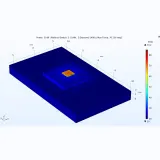
Advanced Thermal Simulation Service Diamond Heat Spreader Performance Analysis
View Specs →
Diamond Heat Spreader With Copper Coated Metalized Surface
View Specs →