Load Reduction and Fragmentation Behavior of Ultrasonic-Assisted Pick Cutting - A Calibrated EDEM–Experimental Study
Paper details
Section titled “Paper details”| Field | Value |
|---|---|
| Journal | Applied Sciences |
| Published | 2026-08-13 |
| Authors | Qianmiao Cheng, Tianjin Wang, Yasi Duan, An Wang, Qiyuan Fan |
| DOI | 10.3390/app16168085 |
Ultrasonic-assisted picking at 30 kHz lowered average cutting load by 74.69% under the selected geometry. The test used a 0.05 mm vibration amplitude, a 40° cutting angle, and a 60° cone angle. Debris yield increased by 54.71%, while mass-specific mechanical cutting energy consumption decreased by 83.63%.
The paper reports these gains against conventional cutting of 21 MPa artificial rock-like specimens. The result comes from calibrated EDEM analysis and laboratory cutting tests.
Calibrated model and cutting method
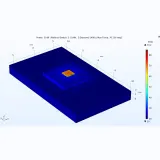
Section titled “Calibrated model and cutting method”EDEM represented the rock with a Hertz-Mindlin with Bonding contact model. Spherical particles were linked by virtual elastic bonds that carried force and moments until normal or shear stress exceeded its failure threshold. Bond breakage represented the development of microcracks and eventual macroscopic fracture.
Calibration used uniaxial compression and Brazilian splitting tests. The artificial rock averaged 21 MPa in uniaxial compression and 1.9 MPa in tension. The model returned about 23 MPa and 2.1 MPa, with similar fracture patterns and stress-strain trends. Its cutting block measured 100 mm by 100 mm by 60 mm, with a 2 mm particle radius and a 2.2 mm contact radius.
MetaParticle analysis grouped particles joined by unbroken bonds into rock blocks for measuring debris mass and size. Simulations used a 0.03 m/s feed, a 10 mm depth, and a 0.05 mm vibration amplitude. The run lasted 3.5 s, with force data saved every 0.01 s.
Frequency gives the best response near 30 kHz
Section titled “Frequency gives the best response near 30 kHz”At 0.05 mm amplitude and a 40° cutting angle, the sweep covered 0, 20, 25, 30, 35, and 40 kHz. The average resultant force fell from 5466.68 N in conventional cutting to 1489.61 N at 30 kHz. It rose to 1763.69 N at 40 kHz, so the response was not a monotonic gain.
| Frequency | Average force (N) | Debris mass (g) | Specific energy (J/g) |
|---|---|---|---|
| 0 kHz | 5466 | 19.36 | 28.23 |
| 20 kHz | 2390 | 25.97 | 9.2 |
| 25 kHz | 1951 | 28.05 | 6.96 |
| 30 kHz | 1489 | 30.58 | 4.87 |
| 35 kHz | 1536 | 27.32 | 5.62 |
| 40 kHz | 1763 | 24.45 | 7.21 |
At 30 kHz, the simulated tangential, lateral, and normal forces were 959.89 N, 560.38 N, and 774.92 N. Force histories showed rapid fluctuations and a lower peak than conventional cutting. A second-order fit gave an R² of 0.94 for force against frequency within the tested range.
The authors attribute the reduction to ultrasonic stress waves that promote microcrack propagation and localized unloading ahead of the pick. They also state that excessive frequency weakens energy transfer, which is their explanation for the rebound above 30 kHz.
Geometry changes load, yield, and efficiency together
Section titled “Geometry changes load, yield, and efficiency together”Within the 30 kHz simulations, the average resultant force fell from 1489.61 N at 40° to 1397.95 N at 45° and 1236.19 N at 50°. Debris mass moved in the opposite direction, declining from 30.58 g to 28.22 g and 24.86 g. Mass-specific energy rose slightly from 4.87 J/g to 4.95 J/g and 4.97 J/g.
With frequency at 30 kHz and cutting angle at 50°, increasing the cone angle from 60° to 80° raised force from 1236.19 N to 2347.00 N. The 80° result was about 89.8% above the 60° load. Debris rose from 24.86 g to 40.11 g, while energy rose from 4.97 J/g to 5.85 J/g.
The geometry therefore has a clear trade-off. A larger cone angle improves output but spends more load per unit mass. The paper treats 40° and 60° as the favorable combination for combined output and energy, although the tabulated 50° case has the lowest simulated force.
Ultrasonic vibration changes the fragmentation product
Section titled “Ultrasonic vibration changes the fragmentation product”MetaParticle groups were single particles, assemblies of 2 to 4 particles, and assemblies of more than 4 particles. At 30 kHz, their masses were 15.16 g, 9.34 g, and 6.08 g, respectively, for 30.58 g of total debris. Conventional cutting produced 8.37 g, 6.54 g, and 4.45 g, totaling 19.36 g.
At 30 kHz, average diameters reached 4.57 mm for small debris, 10.12 mm for medium debris, and 19.29 mm for large debris. The corresponding conventional values were 4.25 mm, 9.56 mm, and 16.08 mm. The authors therefore report greater total spalling and larger average blocks, rather than only finer crushing.
The 30 kHz condition increased the share of small debris slightly but reduced the shares of medium and large debris. All three absolute masses still exceeded the conventional values. This distinction matters when evaluating muck handling because the product is a broader mass distribution, not a simple shift toward one size class.
Laboratory tests confirm the load trend
Section titled “Laboratory tests confirm the load trend”Validation used Portland cement and fine river sand specimens measuring 200 mm by 130 mm by 60 mm. After 28 days of curing, the specimens averaged 21 MPa in uniaxial compression. A welded test rig combined ultrasonic excitation, mechanical feed, and a three-component force sensor. Each reported case averaged three test sets under a one-factor-at-a-time design.
| Cutting angle | Conventional force (N) | 30 kHz force (N) | Reduction |
|---|---|---|---|
| 40° | 4926 | 1247 | 74.69% |
| 45° | 4741 | 1199 | 74.71% |
| 50° | 4220 | 1031 | 75.57% |
All three tests used a 60° cone angle. With a 60° cone angle, 30 kHz assistance cut the average force at every tested cutting angle. At 40°, the force changed from 4926 N to 1247 N. The 74.69% reduction is the headline load value.
At 50° cutting angle and 60° cone angle, the simulation predicted 1236.19 N, while the experiment measured 1031 N. The reported difference was 19.90%, but both data sets showed the same parameter trends.
Experimental debris at 40° and 60° rose from 59.95 g without vibration to 92.75 g with vibration. The experiment used sieve classes below 2 mm, 2 to 10 mm, and above 10 mm, so its size bins differ from the model’s particle-count classes.
Measured energy and debris responses
Section titled “Measured energy and debris responses”At 50° cutting angle, experimental energy rose with cone angle. Conventional values were 42.57 J/g at 60°, 46.95 J/g at 70°, and 57.79 J/g at 80°. Values with 30 kHz vibration were 6.78 J/g, 7.51 J/g, and 10.21 J/g. The ultrasonic case remained below conventional cutting at each cone angle.
At 60° cone angle, experimental debris mass also increased with cone angle. Conventional cutting yielded 47.61 g, 59.33 g, and 73.74 g at 60°, 70°, and 80°. Ultrasonic cutting yielded 71.03 g, 89.46 g, and 104.28 g. The larger cone angles produced more debris, but the load increased faster.
The measured energy pattern agrees with the simulation. Both show that cone angle raises output while reducing energy efficiency. The practical choice is therefore a balance between material removal and the force imposed on the pick.
Engineering implications and limits
Section titled “Engineering implications and limits”Earlier work cited by the authors focused mainly on drilling, PDC cutters, intact specimens, or ultrasonic pre-splitting. The experiments add roadheader pick data and link force, debris, and energy. The authors propose this quantitative parameter set for vehicle-end load monitoring, adaptive adjustment, and energy management in roadheader control systems.
The evidence remains bounded. The model was not calibrated for ultrasonic wave velocity, damping, or attenuation. Artificial specimens did not reproduce natural joints, pores, pre-existing cracks, or heterogeneity. EDEM particles were larger than natural mesoscopic grains, and the groove analysis was qualitative rather than dimensional.
The experiments also held frequency at 30 kHz and amplitude at 0.05 mm, so they did not reproduce the full simulated frequency sweep. The authors suggest lower local wear under ultrasonic assistance, but they did not report a wear measurement or service-life test.
Until those data are added, 30 kHz at 0.05 mm is a laboratory reference for 21 MPa rock-like material, not a validated field setting.
View Original Abstract
Cantilever roadheaders are widely used in medium-soft rock tunneling. However, conventional pick cutters suffer from high rock-breaking load, excessive energy consumption, and severe abrasion, which restrict the performance of roadheader vehicle-end intelligent control systems. Existing ultrasonic rock-breaking studies mainly focus on drilling and polycrystalline diamond compact (PDC) cutters, while calibrated EDEM simulation and experimental studies of synchronous ultrasonic-vibration-assisted pick cutter cutting remain limited. This study investigates the rock-breaking behavior of synchronous ultrasonic vibration coupled with pick cutter cutting using 21 MPa artificial rock-like specimens. A calibrated EDEM simulation model was developed based on the Hertz-Mindlin with Bonding contact model and validated by uniaxial compression and Brazilian splitting tests. Meta-particle technology was applied to analyze fragmentation characteristics. The effects of ultrasonic frequency, cutting angle, and cone angle on rock-breaking load, debris production, and specific energy consumption were investigated through simulations and experiments. An ultrasonic-assisted cutting test system equipped with force sensors was established for validation. Results show that 30 kHz ultrasonic vibration effectively reduces rock-breaking load under the investigated operating conditions. A relatively favorable parameter combination obtained from the numerical simulations consists of an ultrasonic frequency of 30 kHz, a cutting angle of 40°, and a cone angle of 60°. Compared with conventional cutting, the optimized scheme reduces average cutting load by 74.69%, increases debris yield by 54.71%, and decreases mass-specific mechanical cutting energy consumption by 83.63%. This study provides quantitative data support for roadheader vehicle-end intelligent control systems.

Single Crystal Cvd Diamond Plate
View Specs → Electronic Grade Intrinsic Diamond Epitaxial Wafer H Terminated Superior 100 Mosfet Ready Substrate
View Specs →